Sunday, May 25, 2025

Washington State Highway Board

 The Federal Highway numbering system began in 1925, the same year that the American Association of State Highway Officers (AASHO) came into being.

A timeline Washington State, with credit to History Link and the U.S. Dept of Transportation.

1853 - Washington State Legislature is formed, while still a territory. Franklin Pierce is the first territorial governor.

1889 - Washington becomes the 42nd state, on November 11th of that year.

1905 - WA State Highway board is formed. There are one thousand mile of roads and 600,000 residents in the state. Total cars: 100.

1911 - A road tax of 1-mill is established

1912 - The state begins experimenting with concrete

1917 - Locks on Seattle's ship canal are dedicated

1920 - The first airstrips go into service: one in Seattle at Sand Point, and one in Spokane.

1921 - The Columbia River Ferry goes into service. The state board becomes the highway committee, and consists of the governor, the state auditor, and the state treasurer.

1922 - Snow removal from roads in the cascades is started.

1930 - Keller Ferry opens

1935-1967 - Art Deco behemoth the Kalakala ferry in service.

Today there are six regional highway offices, each with a District Enginee.


The Yellowstone Trail

Have you heard of it? I learned about it this year (2025) when contemplating going to the Industrial Strength Bluegrass Festival in Xenia, Ohio. I was thinking about driving--well, I was planning on driving. I found out about the trail when I started to map my route. I bought the book, A Good Road from Plymouth Rock to Puget Sound written by Alice and John Ridge, from the Renville Historical Society and Museum in Minnesota, and was seriously over-stimmed when I got it. It's like a cross between the Farmer's Almanac and a history book. 

I planned to take the trail as much as I could on my way to Ohio, but once I actually did the math, I realized that I would need a month to take the trip at the pace I wanted to. I cut my ambition down to a more manageable size and will probably travel to eastern Montana, and maybe Wyoming. Reading the book as I plan gives me a picture of what it was like when the Yellowstone Trail Association was formed in 1912--bumpy, inhospitable, and lord how did they get gas? All the learning is leading to more questions and more research. For now, until I take the trip, I will keep my notes here on some of the history I want to keep for reference later. 

Thursday, July 28, 2022

Mound Bayou, Mississippi

Isaiah Thornton Montgomery, Founder and Mayor  

The following is a complete excerpt from 1975 Application for Historic status for I.T. Montgomery House in Mound Bayou. It tells part of the story of the town's founding. The house attained listing on the National Register as a National Historic Landmark in 1976.

Located in the Mississippi Delta region of Bolivar County, the town of Mound Bayou was one of a number of black settlements which was established during the post-Reconstruction period. It represents one of many important attempts by blacks of that era to establish independent communities in which they could exercise self-government. 

The present town of Mound Bayou had its inception in a former settlement. Isaiah Thornton Montgomery and his cousin Benjamin Green were the slaves of the family of the Confederate President Jefferson Davis. As an alternative to the institution of slavery, it was Jefferson Davis' idea that blacks be isolated on their own settlements. At the conclusion of the Civil War, in 1865, an actual settlement was established on the former Jefferson plantation of Brierfield at Davis' Bend, twenty miles south of Vicksburg on the Mississippi River. 

The settlement survived for eighteen years. However, because of the problem of recurring floods of the Mississippi, the relatives and friends of Montgomery and Green, all of whom were former slaves of the Davis plantation, abandoned the small settlement and moved to Vicksburg where they awaited another opportunity to establish their own community. 

The Louisville, New Orleans and Texas Railroad was granted a large tract of land in the state. This grant was made to encourage the development of agriculture, trade and commerce in the fertile delta along the Mississippi River from Memphis to Vicksburg. As a result, fruition was given to the establishment of Mound Bayou. It was the belief of railroad company officials that only members of the black race had the ability to adapt to life in a semi-tropical climate which was conducive to maleria (sic). 

The assistance of Isaiah Montgomery was sought in soliciting black workers. He, realizing the possibilities that it offered for another attempt at black self-government, began an immediate investigation of its feasability (sic). He finally decided upon the site of the present town of Mound Bayou, named for a large Indian Mound, located at the site of the convergence of two bayous which drained the region. Many of the settlers of the former colony came to Mound Bayou in July 1887, and began to carve a town out of the wilderness and swampland. It was the inspiration of Montgomery that caused other blacks from Louisiana, Alabama, and Georgia to join the effort. These settlers had one common motivation: they wished to live free from the annoying and unnecessary restraints imposed by continued residence to basic concepts of universal equality.  

The prosperity Mound Bayou experienced, almost from its inception, was attributed to its location along the railroad. Communication was facilitated by trade with other regions of the country by the railroad. Its location in the fertile Mississippi Delta region allowed Mound Bayou to produce cotton on a scale greater than that of any other region in the state. Under the leadership of Montgomery, Mound Bayou by the turn of the century had developed into one of the most prosperous and thriving communities in the state. 

In 1904, the Bank of Mound Bayou was founded by John Francis and Charles Banks. Its rapid growth necessitated the amendment of its original charter to increase its capital from $10,000 to $25,000. By 1907, the largest enterprise of its kind in the state, the Mound Bayou Oil Mill and Manufacturing Company was erected at an investment cost of $100,000. Finally, in 1912, Mound Bayou's petition to Mississippi Governor Earl Brewer for a town charter and status as a town was immediately accepted. 

The charter established an aldermanic form of government with a mayor, town marshall, and five aldermen as the elected officials. Throughout most of the town's history, these positions have been held by black men and women. In the realm of education, teaching and learning played a significant role from the town's beginning. 

In 1892, the two co-founders, Isaiah Montgomery and Benjamin Green, recognizing the importance of schools, donated a tract of land for educational purposes. Montgomery's sister, Mary, a former student of Oberlin College, was the town's first teacher giving instruction in her home. The American Missionary Association joined with Montgomery and Green in their efforts and for twenty years the organization assisted them by sending money, supplies and teachers to what soon became known as the Mound Bayou Normal and Industrial Institute. Professor B. F. Ousley was the first principal, serving in that capacity for more than sixteen years. Finally, in 1920, the school was enlarged into the Mound Bayou Consolidated Public School. 

It was the only school for black children in the county. Moving into a three-story, fireproof brick building with sixteen well-equipped classrooms, an auditorium, the school had an enrollment of 850 students. The school's first two principals, Professor J. M. Mosley and Professor John H. Powell, were graduates of Alcorn College in Lorman, Mississippi. In addition to the conventional diploma-granting curriculum, the high school soon offered vocational training in the industrial arts, agriculture, stenography, typing and bookkeeping. 

By the turn of the century, Mound Bayou had begun massive improvements in its physical appearance. Numerous shops, stores, fraternal buildings, institutional buildings and private residences were constructed. It was likewise during this period, 1910, that the Isaiah T. Montgomery house was constructed. This house stands typical of the progress and the development of the town. 

It was through the direct efforts of I.T. Montgomery, who was founder and first mayor of the town, which inspired and helped lead the town to its productive years. Montgomery possessed a diversified background with experience in accounting, real estate and civil engineering--not to include his effectiveness as a politician. Montgomery was most active in the Republican Party, and he represented Bolivar County in the Mississippi Constitutional Convention of 1890.

Having vested interests in real estate, Montgomery grew in this black community, to be one of the wealthiest men in this county, black or white. Isaiah T. Montgomery died in 1924 leaving a legacy of industrious leadership. Through his successful accomplishments during the post-Reconstruction era, he negated the accepted postulate that blacks were incapable of independent community development and self-government.

The house is a 1910 red brick structure of two stories over a full above-grade basement, irregular in plan, with hipped roof and gables over projections. The front has a spacious porch with square Doric columns resting on brick piers extending to grade, and is reached by a wide flight of masonry steps. The windows are single light double-hung wooden sash. The double front doors have a transom, full width of the opening. The com ice is of simple treatment consisting of frieze board and extended eaves board  

Sunday, May 1, 2022

Qualified Immunity--Why is it un-understandable?

Qualified immunity isn't an easy concept to grasp. There isn't an elevator pitch. It's pretty involved. But let's start with this:

Every person in the United States has rights that are protected. Also true is the fact that governments have made themselves and their 'agents' somewhat invincible when it comes to lawsuits. 

Painting of King George III

Recall that this country supposedly wanted to break up with King George III, in part because he was unaccountable; he was immune from prosecution. Our bewigged forebears didn't like that. It's known as sovereign immunity, and it's part of why they dumped him.

However, when the chips were down and the quill pens were out, the ancestral legislators of the so-called Land of the Free decided that well, maybe a little immunity wasn't such a bad thing for them, as a government. And so, they put sovereign immunity into the Constitution. There's a little YouTube primer here

Then the states put sovereign immunity into their statutes as well. They also added governmental immunity, which gives protection from suit to state and local governments and agencies.

It was only natural that this immunity would trickle down to the individual, and so you have qualified immunity for an agent of the state. But qualified immunity was developed solely by the courts--the judicial branch instead of the legislative branch.

In real life, qualified immunity takes away the rights supposedly guaranteed to the people by the government, and says, "okay, now prove that you can have these rights, and once you've done that, prove that they were violated." 

That's what this post is about: these rights have never been granted to everyone, and haven't been protected or enforced by any level of government with consistency and equity. 

Qualified immunity means you can get injured, wrongly arrested, beaten, wrongly convicted, maliciously prosecuted, killed--it's endless--and you likely won't have any recourse if those deeds have been committed by law enforcement. It will take years and even decades to get a final decision on whether your case can even be brought for trial. That's right. You have to bring suit to see if you can bring suit. And you're paying for it all the while, unless an advocacy organization has agreed to help you.

It becomes even more convoluted if a federal officer violated your rights; they are virtually untouchable, and were recently made more so by the U.S. Supreme Court in Egbert v. Boule.

If you've done some reading on the civil rights struggle during the 1960's, it's clear that Black Americans did not have the rights enumerated in the U.S. Constitution. These rights were kept from them through violence, intimidation, control of the workforce, mass incarceration, sharecropping, and more. Much of this was enforced or committed by local police, who were acting illegally, immorally, and unethically. It wasn't just happening in law enforcement: these violent and repressive tactics were permitted by the criminal legal system as well. 

Qualified immunity actively supports the violation of civil rights, and increases police misconduct and leaves victims without any recourse. Qualified immunity can be eliminated at the State level. Do you know what your state statute says about immunity for government officials? 

More Reading
Qualified Immunity (americanbar.org)


Hamdi Mohamud--Wrongly arrested and incarcerated in 2011. Still waiting for justice in 2022.

Here is just one case that shows some of what's involved in seeking restitution for a violation of constitutional 'rights'. It's life-changing and frightening, and it can happen to anyone. 

Hamdi Mohamud

Hamdi Mohamud, Credit: Institute for Justice
  • Rights violation took place in 2011
  • Ms. Mohamud was wrongly incarcerated for two years at age 16. One of those years was spent in federal prison.
  • Still waiting for her case to be heard in 2022

Hamdi Mohamud was arrested at the age of 16 and incarcerated for 2 years without a trial based solely on false information provided by a police officer. Eleven years after her initial arrest and eventual release, the case against the officer that provided bogus evidence against her still has not been allowed to go to trial.

In June 2011, 16 year old Hamdi Mohamud and a friend were innocent bystanders during a fight involving three older girls. St. Paul police officers responded when Muna, one of the older girls, attacked the others with a knife. Unknown to responding officers at the scene, Muna was an informant in separate investigation by a federal task force. Heather Weyker, an officer on that task force, hearing about the incident, convinced responding officers to free Muna, and arrest the other girls in an effort to protect her own informant in an investigation that later turned out to be meritless.

The day after the initial baseless arrests, officer Weyker filed a federal criminal complaint and affidavit with information that she knew to be false in an effort to enforce the detention of the innocent girls without probable cause. There are many news stories about Officer Weyker's documented lies. Although Hamdi was never involved in the initial altercation and should never have been charged with any crime, she ended up spending 2 years in detention, including 1 year in federal prison without ever receiving a trial.

Upon dismissal of the charges against her, Ms. Mohamud sought to hold officer Weyker accountable for her actions. Like many victims of police misconduct, she then entered a world of protracted litigation that victims are forced to engage in if they seek any recourse for a violation of their Constitutional rights.

Police routinely claim qualified immunity to have cases against them dismissed before trial, and they are able to appeal denials of their claims all the way to the U.S. Supreme Court. Victims can only bring cases of police misconduct to court if all appeals for qualified immunity have been denied and this can take years.

Officer Weyker was initially denied qualified immunity and Ms. Mohamud's case against the officer was allowed to proceed. Weyker appealed, and the 8th Circuit Court of Appeals ruled that because Weyker was deputized as part of a federal task force at the time, Ms. Mohamud could not sue Weyker in her capacity as a federal officer.
 
In a follow-up appeal filed with the U.S. Supreme Court, the issue was summarized as follows:
 
“The officer, Respondent Heather Weyker, was denied qualified immunity because ‘a reasonable officer would know that deliberately misleading another officer into arresting an innocent individual to protect a sham investigation is unlawful.’
 
To resolve the growing circuit split on the application of Ziglar v. Abbasi, the question presented is: Whether a constitutional remedy is available against federal officers for individual instances of law enforcement overreach in violation of the Fourth Amendment.”
 
Ms. Mohamud is represented by the Institute for Justice. See more details of the case and access court documents here.

The Institute for Justice also has a helpful FAQ on qualified immunity here. For a brief explainer of qualified immunity, see this post.


Wednesday, June 16, 2021

You Have to Search for your History

 May 17-21


On the banks of the Arkansas River, at the foot of the Edmund Pettus Bridge, is the Selma Memorial that commemorates "Bloody Sunday". In the scant teachings our country doles out about the civil rights struggle, you may have seen the shocking footage of that day. You may know less about the organization leading up to it, the reason for the march, and what happened afterwards. 

As author Gay Talese points out in this video, most of the moments we see are "isolated examples of atrociousness. We told the world that this quarter of a mile is the story, and it has remained the story for over fifty years. . . but really, Selma hasn't changed that much. . ."

Talese is confirming my own experience that many of us have seen these few vignettes of outrageous racist violence against non-violent protestors, but we never get to see the whole picture. We usually have to look for it, which was my intent with this trip.

I was at the riverside memorial in Selma one afternoon, reading Charles Person's book Buses Are A-comin' when a woman walked past. Not many people were around--Selma is very quiet, most businesses were out of business or closed, so there wasn't much happening. For some reason I made eye contact--something I had generally avoided during this trip. I can't remember what we started talking about, but I must have a sixth sense about people from the Pacific Northwest because she was from Seattle also. Another solo traveler on the Civil Rights Trail, she was headed from Selma to Birmingham, and had just been to the Equal Justice Initiative in Montgomery.

We both expressed similar incredulities, which centered largely on our lack of civil rights education and our own search to face up to and eliminate racism. When we talked about seeing the lynching memorial in Montgomery, she said she had seen one portion where there were an overwhelming number of 'unknown' people who had all been lynched on the same day. That evening, she asked a friend about it. The two of them regularly talk race and rights. He did know about the lynching--it happened the day before an election. All of those 'unknown' people had been killed to stop them from voting. 

Her friend said something like, "You have to search for your history", when she expressed frustration about the hiddenness of these facts. That's really the truth about American education: what you learn in K-12 is sanitized, politicized, and infantilized. A useful education teaches you how to search for and critique your own history, whatever that may be. Looking at everything that has roiled the U.S. over the last five years, it's an undertaking I hope some will engage in seriously. Even then, it's up for interpretation given who generally has the storytelling rights.


Additional Reading/Listening/Watching

Assignment America: Selma, by Gay Talese, New York Times
1619, a podcast by Nikole Hannah-Jones

Friday, May 28, 2021

Birmingham Alabama


May 13-15

Birmingham, AL


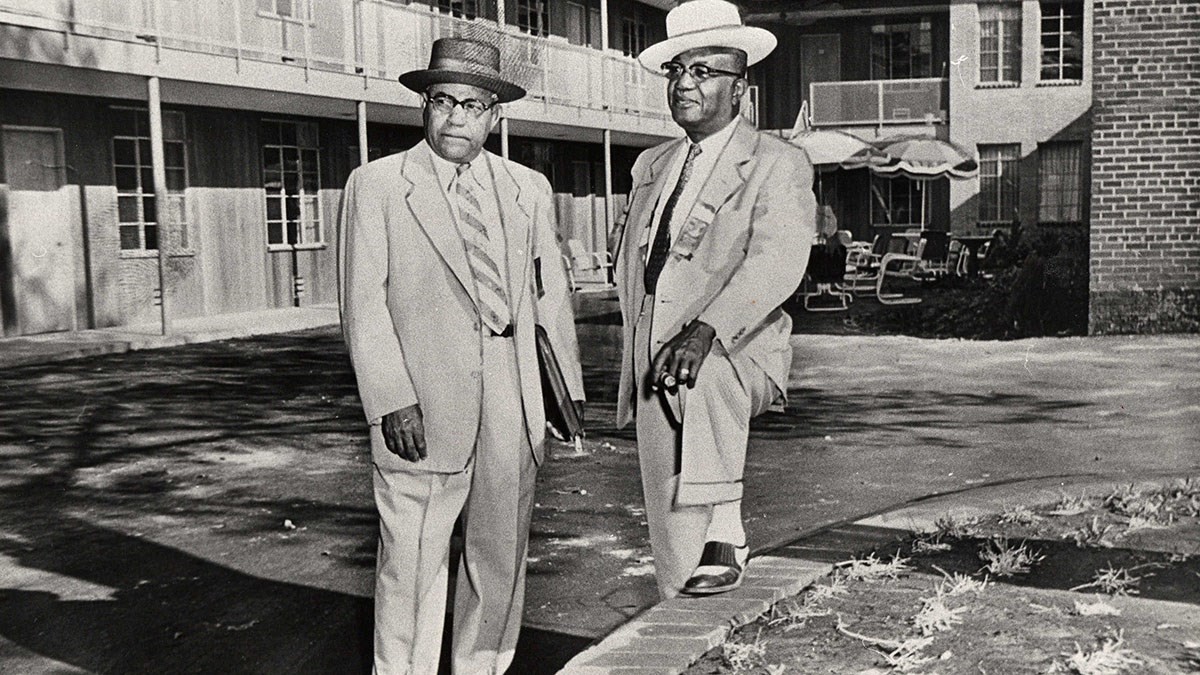
A.G. Gaston (right) in front of his motel with R.A. Hester. City of Birmingham Archives


Arthur George Gaston died in 1996 with a net worth of $130 million. He was an innovator from the beginning, first earning some cash by letting the neighborhood kids ride his tire swing in exchange for their buttons, which the children's parents would buy back from him. As a young adult, he was a miner in Birmingham and provided lunches and burial insurance to his coworkers.

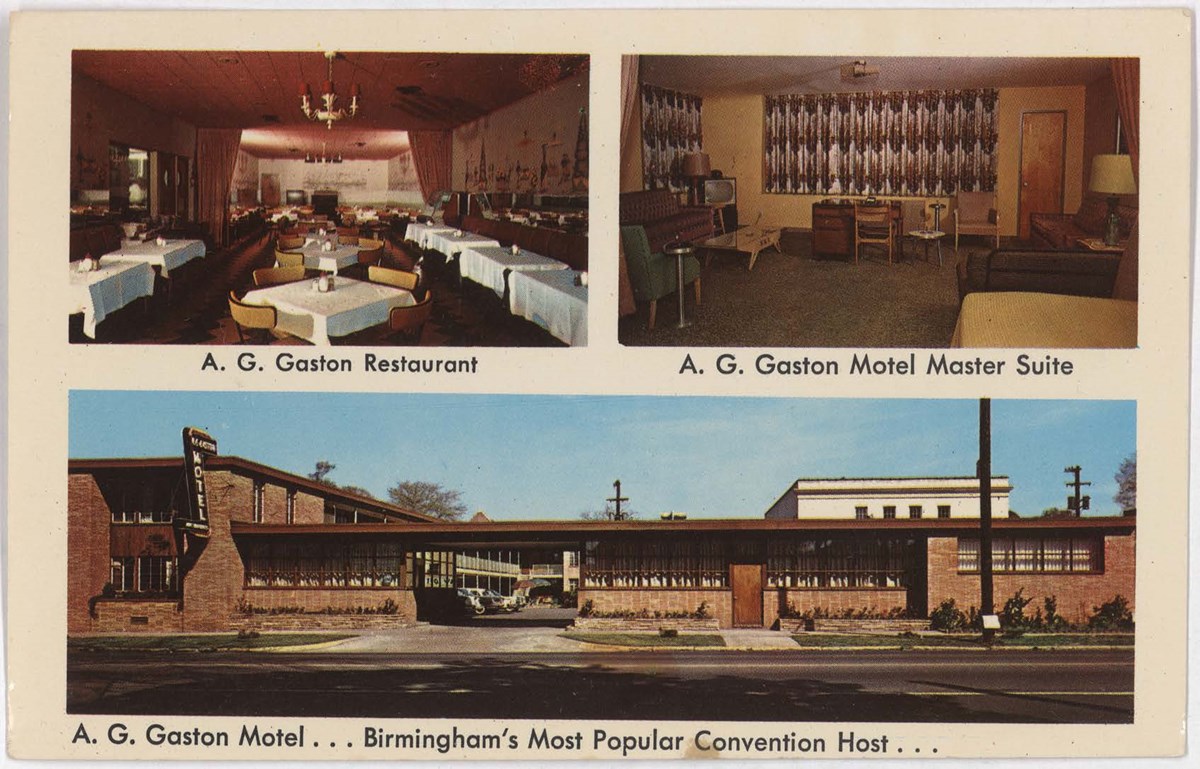
Gaston opened a business school, a funeral home, a savings and loan, and the A.G. Gaston Motel, which was listed in the Green Book. While he generally laid low to keep out of conflict with white society, he did provide financial assistance to the Civil Rights movement, and opened his motel to activists in the early 60's.

Dr. King stayed there during the Children's Crusade in 1963, a march in which children left school to walk downtown and talk with the mayor about segregation in Birmingham. Bull Connor, "Public Safety" officer, stopped the marches by using fire hoses and police dogs against the students. Here is the National Park Service narrative about the Motel and why it is part of the Birmingham Civil Rights National Monument.

The events of the Children's Crusade led to the arrest of Dr. King. Gaston's Motel was bombed; two devices exploded near Dr. King's room. Four months later, on September 15, 1963, four Klan members killed four girls and injured 14 others. The four who died were Addie Mae Collins, Cynthia Wesley, Carole Robertson, and Denise McNair. Addie Mae's sister, Sarah, was partially blinded in the explosion. 

Gaston put up $160,000 bond for Dr. King.

A postcard from the Gaston Motel


2019 unveiling of A.G. Gaston Boulevard signs at the Gaston Motel. Bham Now


Gaston Motel renovations underway during my visit. The firm completing the renovation is A.G. Gaston Construction.


A.G. Gaston Building, right across the street from the Motel. I love this building.

More about Birmingham's people and industry

Hosea Hudson was an ironworker, and organizer, and a member of the Communist Party. He also sang bass in the L&N Quartet. He grew up as a Georgia sharecropper and worked in Atlanta and Nashville before heading to New York City to train with the Communist Party USA. Hudson settled in Birmingham as a WPA worker, joining the United Steelworkers of America during WWII. Ultimately, he was fired and blacklisted because of his communist affiliations. Birmingham Mayor Richard Arrington designated February 26, 1980 as "Hosea Hudson Day". Nell Irvin Painter worked with Hudson on her biography of him, The Narrative of Hosea Hudson: The Life and times of a Black Radical.  Hudson wrote his own book in 1972 entitled Black Worker in the Deep South: A Personal Record.  
Sloss Furnaces


Sloss Furnaces used Black workers for the manual jobs in the plant, and whites for managerial roles. It also used convict leasing, a continuance of the system of slavery that was profitable for businesses and for local governments. The company had its own prison system. Alabama was the last state in the Union to do away with convict leasing in 1928, although many counties in the South continued to use the system. Sloss was segregated, with separate bath houses, separate time clock areas, and separate company picnics.


And some food
I picked up a catfish sandwich and fried green tomatoes at Green Acres Cafe. Delicious.


More reading

Audio and Video
A.G. Gaston Episode of Driving the Green Book, Alvin Hall and Janee Woods Weber.
video piece on Gaston's businesses and his support of the Civil Rights movement. 
A video piece on Black workers at Sloss Furnaces.

Wednesday, May 26, 2021

Direct Action and Activist Discord; Birmingham, AL

May 13-15, Birmingham

I'm doing this trip backwards--that is, I'm doing it the opposite way the arrows show in the guide book. I suppose there's no real wrong way to do this, but it's working for me this way. Starting off with Little Rock was chronologically correct, but of course next I went to Memphis, and the assassination of Dr. King (1968). What Memphis gave me, though, was some familiarity with the leaders and activists I was to meet over and over as I went from Birmingham to Montgomery, to Selma, and finally Jackson, MS, and the Delta.

In Birmingham, a few things came together for me: a prominent part of Green Book, the Freedom Rides (1960-1961), and Dr. King's Letter from a Birmingham Jail (1963). If you haven't ever read King's Letter, set aside a few minutes for it. He was jailed in Birmingham for 'parading without a permit'. He wrote the letter on scraps of paper that were smuggled in to him.

Most of us know that Dr. King's strategy was one of non-violence. Not everyone in the movement agreed with that strategy (Kwame Ture was one), but everyone who took part in direct action committed to following non-violence without exception. They were even trained through role-playing to endure violence and humiliating acts against them. King talks about this commitment in his letter. Written in 1963, after the Montgomery Bus Boycott that he was asked to lead in 1955, and after the Freedom Rides (1960-61). With years of experience in both direct action and negotiating with political and law enforcement leadership, Dr King had seen the pattern of tactics used by segregationists and he lays them out in the letter. 

Dr. King's letter could have been written by someone from today's Black Lives Matter protests.  He mentions the following, all of which are present in today's discourse about BLM direct actions:

  • City leadership's objection to 'outsiders coming in'
  • City leadership insisting on negotiations, which King's movement has done, but leadership did not keep their promises.
  • Being told to wait, for any reason. This 'right time' argument is one we see most frequently after mass shootings now, as those against gun control come out and say that now is not the 'right time' to talk about gun control.
  • Black people are dying while city leadership keeps moving the goal posts. In short this is a feature of respectability politics, and if you're a supporter of justice movements, it's easy to fall for this argument--you may be the white moderate that Dr. King is talking about.
  • City leaders and police calling any protest an 'unlawful assembly' to violently shut down non-violent protests.
  • Creating laws or regulations that criminalize or ban first amendment activities.
The 'unlawful assembly' label is applied quickly today, but unequally for different groups.
The BLM protests in Seattle and Portland in the summer of 2020 were quickly labeled by police as 'unlawful assembly', warnings were given that non-lethals would be used if protesters did not disperse. The next thing that would happen is police would begin using tear gas, flash bangs, and then form a line and forcefully and quickly shove protesters back while continuing to use tear gas. Having been in the crowd for a number of these, the last time was enough for me to quit direct action and join a research group instead. 

Unlike the BLM protests, white nationalist groups like the Proud Boys were protected by law enforcement during their protests, and any counter protesters with an anti-racist bent were the target of both law enforcement and the white nationalist group. Oregon's Statesman talks about this disparity, and a Washington Post piece on the teen who shot and killed two BLM protesters and whose attempt to surrender for the killings was ignored by police echo the events of the 1960's direct action events.

Did you lose focus?
The narrative that was put forth by the police--then and now--was that protesters had become violent or begun destroying property. Whether that was true or not, the protesters were considered 'wrong', and government officials did not back down, but rather tightened restrictions. The focus had now become about tactics, and how the protesters behaved. And hey presto, the issue of police brutality against Black Americans, segregation, or voting rights was in the background. Be aware that if you're arguing about what tactics protesters are using, you're missing the point. Go back and remind yourself of the issue being highlighted by the protest and focus on that. Property cannot be the victim of violence, but when property damage occurs during protests, it is often labeled 'violence'. 

We know now that the story of the civil rights protests often framed the protesters in a bad light. The same thing is happening now. We also know that in many cases, law enforcement have committed violent, criminal acts against Black Americans and have lied about it, then and now. Police body cams and bystander video have verified this, as with the murder of George Floyd. It's important to understand why Colin Kaepernick took a knee during the national anthem, and for us to refocus on the issues with family and friends. Each one of us has an obligation to bend that arc of the moral universe.

More Reading

The Rise of Respectability Politics, Frederick C. Harris, Dissent Magazine

Stop Hustling Black Death, Imani Perry, The Cut

Letter from a Birmingham Jail, Dr. Martin Luther King, Jr.

Why MLK was Jailed in Birmingham, Lily Rothman, Time Magazine

FBI Files on Freedom Riders

Note that even though Albert Boutwell (shown above) won the Mayoral election, Birmingham's "Bull" Connor refused to give up his office until directed to do so by the Supreme Court of Alabama.  Connor was the face of institutional racism, with many atrocities against Black residents. He famously told white supremacists they had "fifteen or twenty minutes before I show up" when the Freedom Riders came to Birmingham. You can read about that here.


Saturday, May 22, 2021

Canton Freedom House, Canton Mississippi

A note about pictures throughout this blog: not all of these will be great! That's because my main focus is hearing from the people who are sharing their stories. In most cases, I take these to capture the information on plaques, or to help me remember all I've seen.

May 21, 2021

Canton Freedom House is about ten miles outside of Jackson, MS. It's a civil rights museum that shrinks the decades between the Freedom Summer and today. This is a place that was the headquarters for the Congress of Racial Equality (CORE), and was also used by the Student Non-Violent Coordinating Committee (SNCC, pronounced "snick"). 

George and Rembert Washington 

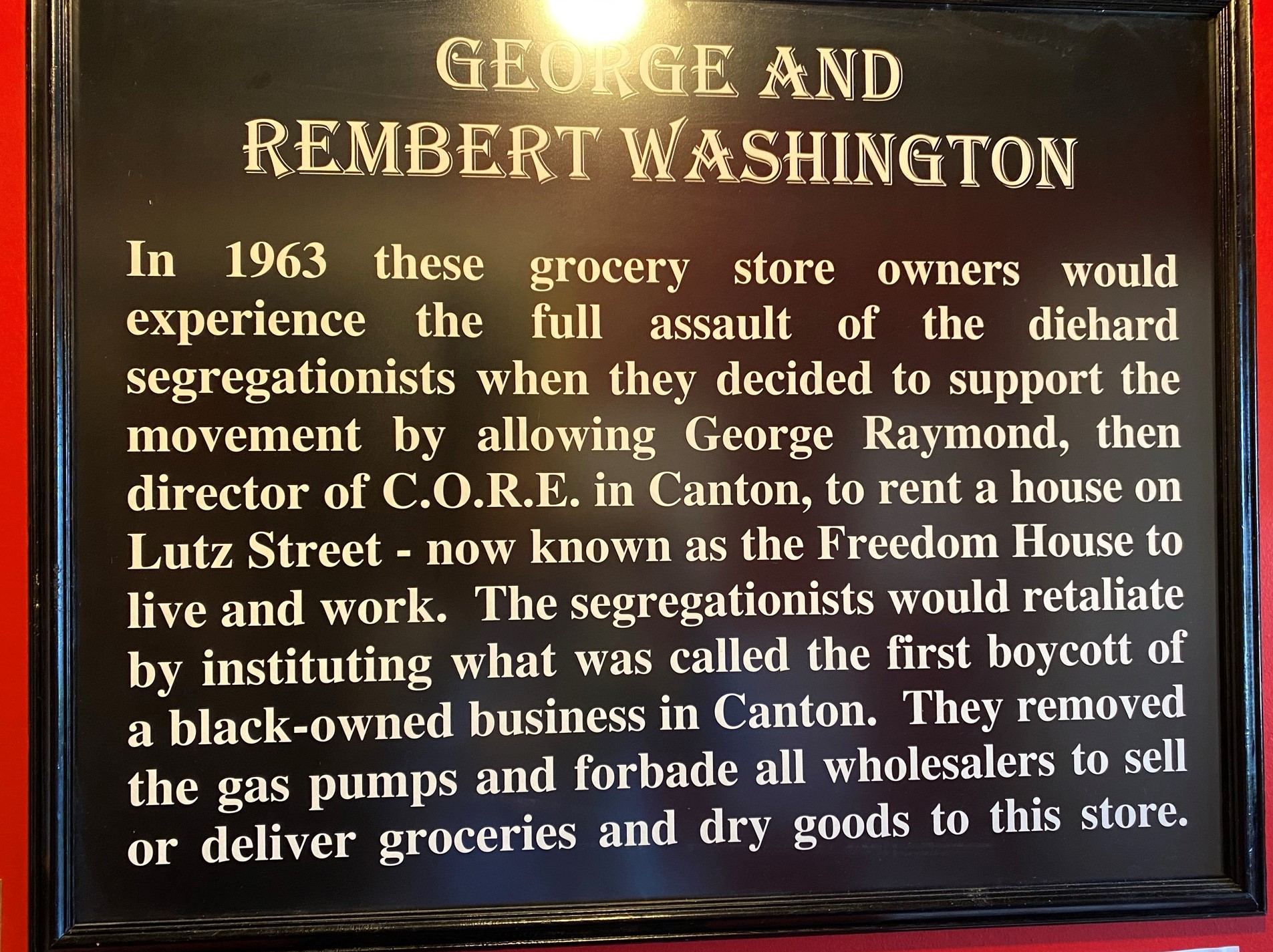
George and Rembert Washington are pictured above in front of the store they owned and ran. They also owned the building across the street, which became the Freedom House. Like many who were active in the civil rights movement across the south, the Washingtons' business and buildings were attacked, and Mr. Washington was arrested and fined for 'offenses' like trash-burning.


The plaque above details the Washingtons' involvement in the movement, and some of the consequences of it. the notice below details Mr. Washington's arrests and fines, and some of the violent acts directed at them. One of the curators explained that they learned that putting chicken wire over the windows stopped molotov cocktails from breaking windows and setting the building on fire. The chicken wire had saved them from numerous attacks.

The Freedom Summer was in 1964, with its focus mainly on registering voters in the South. Poll taxes, literacy tests, intimidation, violence, and straight up murder were some of the tactics that Southern whites used to keep Black voters away from the polls. Only 7 percent of Black Mississippians were registered--the lowest level in the nation.

The formation of the Mississippi Freedom Democratic Party was also a focus of the Freedom Summer agenda, along with the establishment of Freedom Schools. The Freedom House in Canton is the only such place that has survived, and its curators, who were young teens at the time, remember the activities, the comings and goings of Dr. King, James Meredith (he integrated University of Mississippi), Fannie Lou Hamer, James Farmer, Kwame Ture (Stokely Carmichael), and others.

During my visit, curator Wesley Rushing told me the personal story of moving to Canton when he was about eleven. Up until then, his family had been sharecroppers on a plantation in the Delta. Because the landowner cheated the farmers, they always 'owed' the owner money at the end of each year. The plantation had a creek running around it, and there was only one way on and off--right past the owner's house. So they couldn't just move without paying what was 'owed'--$900. The family borrowed the money from friends in Canton, paid the owner, and moved off the plantation. 

This is a common sharecropper's story, and many sharecroppers, like Fannie Lou Hamer, were evicted from their homes and what little livelihood they had when they registered to vote, or took part in any of the rights activities. Just outside of Selma, civil rights workers built a tent city for sharecroppers who had been evicted after taking part in marches. The National Park Service has some personal stories here.

Wesley Rushing said he never finished high school because working as a sharecropper meant he could only attend school in December and January, when there was less work to be done. He was so far behind in school, he wouldn't have graduated until his early twenties, and he was already being badly taunted by schoolmates. He went to work in a steel mill and retired with a good salary.

Friday, May 21, 2021

Lennon Jones, Public Service Hero (Arkansas)

 Little Rock, AR State Capitol

May 8, 2021


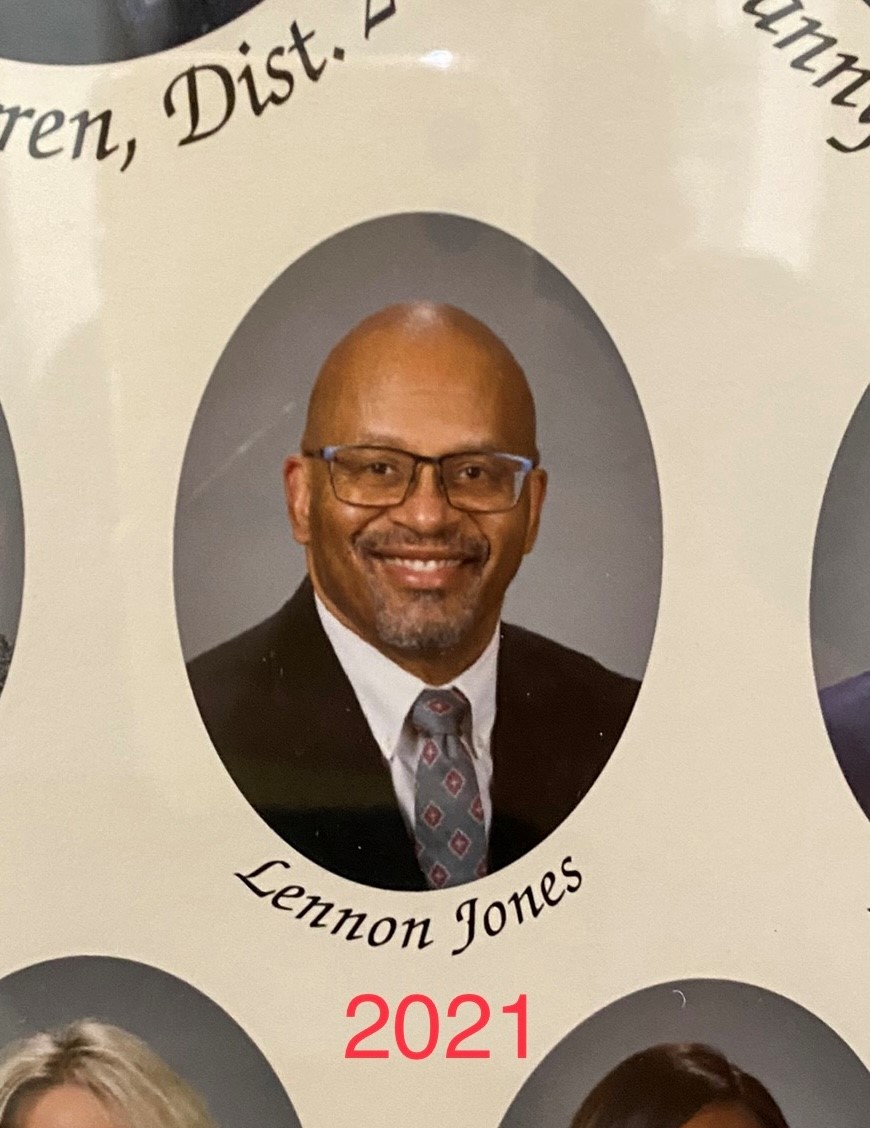
Just a brief recognition of long-term public service hero Lennon Jones. He appears here in the two 'class photos' that record his span of service: 1991-2021. He's still there! He is the Properties and Facilities Manager at the Arkansas State Legislature. I hope your retirement account is bursting. Yes, this means I looked through decades of class photos of this legislature. It was interesting. In the very early days, they included children, pages, and spouses.

Thursday, May 20, 2021

A Carport is Many Things

May 20, 2021
Jackson, Mississippi
Visit to Medgar and Myrlie Evers' Home

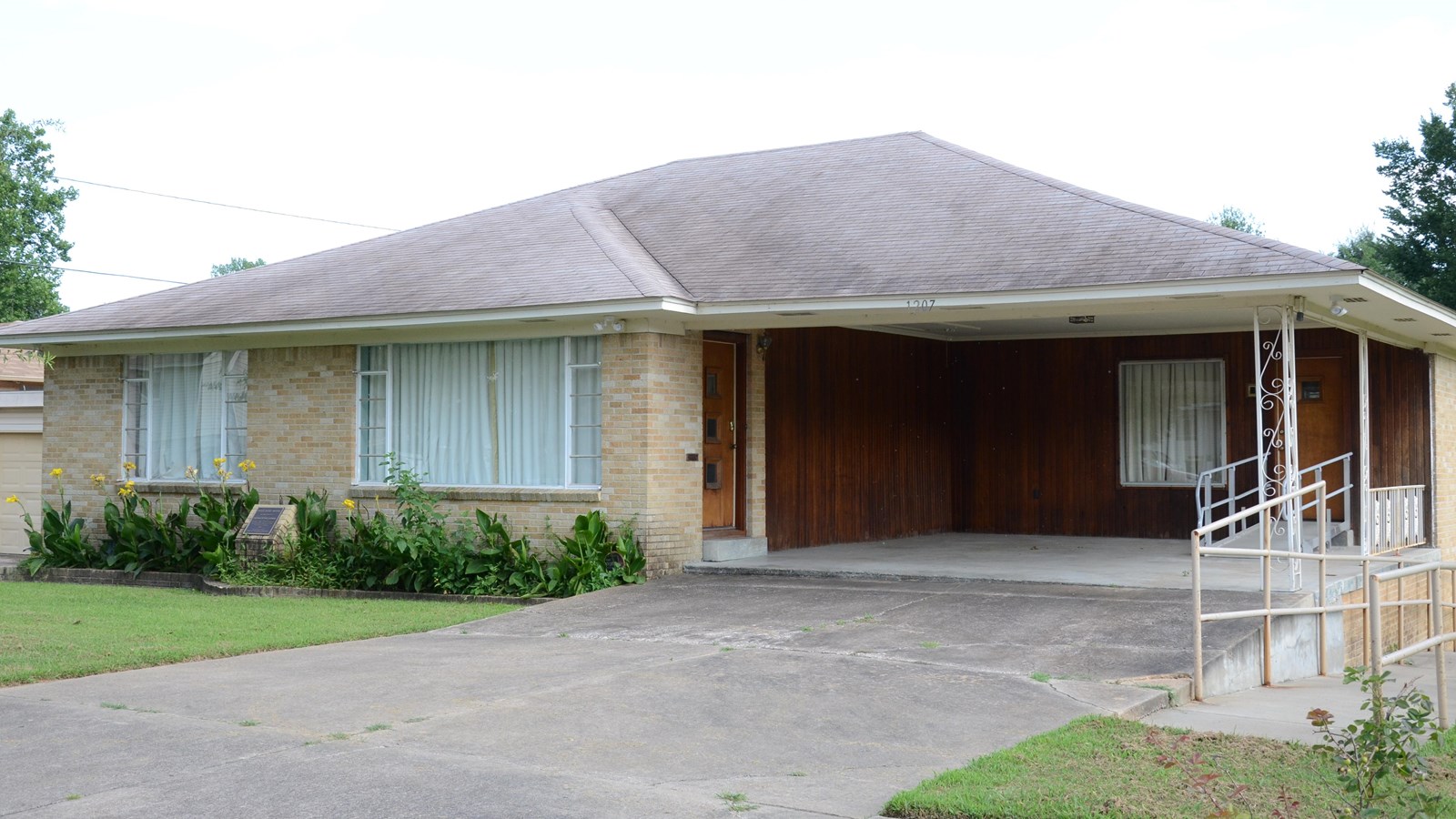
Former home of my grandparents in Lancaster, Ohio. Built 1959.

My grandparents' house in Lancaster, Ohio had a carport. None of the many homes (over 10 of them?) I lived in as a child ever had one, so their carport was a unique little adventure when our family would visit during the summer. It was adjacent to their neighbor's carport, but was about four feet lower, so there was a little wall that gave the space an even cozier feeling.

My grandpa used to smoke his pipe out there after dinner, sitting on the low wall, with his foot up on the milking stool. I loved the smell of the pipe smoke, the warmth of the summer evening, and the fireflies. It's different than hanging out in the driveway, which would be weird. For many people, it's like an outdoor living room. The acoustics are different, and you can stand out there during a belligerent midwestern rainstorm and feel safe from potential danger. This is how one should feel in their own home, or that of a beloved family member, right? 

Daisy Gatson Bates and L.C. Bates home. Built 1955.

Daisy Gatson Bates' Little Rock home had a carport, too. At her home, she received bullets in the mail, harassing phone calls, and white supremacists regularly threw rocks through her windows. When she was a young child, her mother was raped and killed by three white men. Home wasn't a safe place for Mrs. Bates or her mother, Millie Riley. Mrs. Bates was the President of the Arkansas NAACP, and critical support to the Little Rock Nine.

Medgar and Myrlie Evers' home. Built 1956.

When I stood in Medgar and Myrlie Evers' carport this evening, I felt a similar serenity, coziness, and shielded safety that I had felt in my grandparents' carport. The Evers' carport had muffled acoustics, too. The neighborhood was quiet. Yet the Evers family didn't feel safe and in fact weren't safe in their home. Mr. Evers insisted that the children's mattresses be placed directly on the floor so that they were less likely to be hit if someone shot at the house. He did drills with them to prepare them for shootings or bombings. 

Medgar Evers was the NAACP's first field secretary. He was shot to death in his carport on June 12, 1963. He was initially refused medical attention at the hospital, which was for whites only. He was buried in Arlington National Cemetery. He was a 37 year old father of three.

Tuesday, May 18, 2021

Putting Pieces Together: Pop Culture is a Teaching Tool

Memphis
May 11-13

View of the Lorraine's classic sign
with the motel in the background


The wreath on the balcony is a replica of the one placed
 there after Dr. King's assassination.

The Lorraine got me started.

Popular culture can be a good teaching tool. Take Watchmen. I learned a lot about the Green Book, I learned about the Tulsa Massacre, I recognized Emmett Till in the story, and felt the terror of a sundown town. There is probably plenty I missed. Here's a link from BET going over some of the history covered. 

Likewise, hearing about the Lorraine Motel on Driving the Green Book sparked my interest in learning more about trying to travel and move about the country as a Black person in America. We see only some of what goes on today. Driving the Green Book gives you the details that fill out the truth of taking a trip prior to 1970 in the U.S.

Pack all your food because you won't be able to buy any on the road. Bathrooms? Hotels? Gas? Good luck. Travel for Black Americans was dangerous enough during Jim Crow, and without the Green Book, it would have been impossible. The book was filled with businesses that would serve Black customers. Imagine putting that together in a time when there was not only no internet, but many people did not have telephones. Who better to write a book like this that someone with a lot of human contact: Victory Hugo Green, a postman.

The Lorraine is a real place.
The Lorraine, I learned, is not just the last place Dr. King spoke to a crowd. It was a haven for black travelers; a unique endeavor built in the 1920's and bought by Loree and Walter Bailey and renamed the Lorraine and began serving Black travelers in 1945. It wasn't just a welcoming place for travelers. It was a place for Black performers and athletes to stay when visiting or performing in Memphis.

In April 1968, Dr. King was visiting Memphis as a part of the recently-launched (November 1967) Poor People's Campaign, an attempt to focus on economic inequality and poverty. He had also been supporting and strategizing with the AFSCME Sanitation workers weeks before, delivering his "Mountaintop" speech to them on April 3rd. He was assassinated the next day.

Scatter the pieces
Many of us have learned just a few things about the Civil Rights Movement, Jim Crow, and/or slavery. Some of us vaguely remember something about 'states rights'. That's actually what I was taught the Civil War was about. Neither the concept nor the mechanics of states rights made sense to me as a fifteen-year-old. As I've said, my parents never talked about this time. (It was all Nixon, Nixon, Nixon in our house. I remember that much)

Pop culture helped me put some pieces together: the Green Book, the Lorraine Motel, and Dr. King's assassination. Each day on this trip, I gather more threads, more connections. How many civil rights museums have I been to at the time of this writing? At least four? And yet I learn many new things at each one. The picture becomes clearer, the lines of connection thicker. It starts to make sense as a continuum. The line from slavery to today is clear and the behaviors of intimidation, oppression, violence, and lawlessness on the part of white people against Black Americans is loud and impossible to ignore.

Why didn't I know these things? Because if you scatter the pieces far enough, you can't see the patterns and connections. Which means the chance that someone will uncover your crimes is lower. lack of knowledge about the machine keeps the machine running. I'll have more about these connecting pieces in other posts.

Continuity of today.
Today, the Poor People's Campaign is alive and well. It is spearheaded by Reverend Dr. William Barber II, who is an inspiring and empathetic speaker whether you are religious or not. The platform of the Poor People's Campaign may sound familiar to you from Bernie Sanders' campaign.

Americans Who Tell the Truth is a beautiful website that makes the people who make a difference come to life. You can check out activists and leaders by sortable categories (including centuries!) on the linked site.

Some examples of my current heroes are:
Bree Newsome Bass, the hero who removed the confederate flag from the State House in South Carolina.
Alicia Garza, who began the Black Lives Matter movement in 2013 with Patrisse Cullors and Opal Tometi after the murder of Trayvon Martin.


Other Resources and Info


What did I see in Memphis?
Lorraine Motel: Quality accommodations for Black people, civil rights leaders planned and strategized here, Dr. Martin Luther King, Jr. was assassinated on the balcony here. It is now part of the National Civil Rights Museum in Memphis.
W.C. Handy House: Handy was the "Father of the Blues". His bio is linked, and fascinating.
Beale Street: historically Black business district
Ida B. Wells was a journalist and activist; she owned and ran two newspapers in Memphis. Please read her bio. She has many accomplishments.

Recommended Reading
Labor Power is the Key to Racial Equity, Thomas Geoghegan, The New Republic
The Negro and the Labor Unions, Booker T. Washington, The Atlantic

W.C Handy's House. So cute!


Saturday, May 15, 2021

Arkansas National Guard Prevent School Desegregation - 1957 | Today in ...

The Little Rock 9 Began as 200

May 8-May 11, Little Rock, Arkansas

Little Rock, AR qualified for the Civil Rights Trail when government officials, supported by overt and covert tactics used by Little Rock residents, refused to allow and violently opposed integration of the Little Rock school system. 

In Context

It's 1957, two years after the murder of 14 year-old Emmett Till. No one was ever held accountable for his murder. It's also two years after Rosa Parks' bus ride in Montgomery, AL, which sparked sit-ins and freedom rides all over the south.

Legal precedent has been set by the U.S. Supreme Court in Brown v. Board (1954), which struck down 'separate but equal', finding that separate educational facilities are inherently unequal. It was followed by what is known as Brown II, which required desegregation of schools 'with all deliberate speed'. And yes, that language was vague enough to cause glacially-paced planning where desegregation could be pushed off into future decades. 

200 Black students filed to enroll in Little Rock Central High School

After Brown II, the NAACP worked to register students all over the south in whites-only schools. Little Rock school board decided to desegregate and wanted to start with kindergarten, adding a grade level each year. Whites complained about the plan and fought to have integration begin with high school. Two hundred Black students filed to enroll. You can imagine the machinations that took place for that number to be whittled down to about 90. Out of those 90, how do we end up with just 9? Intimidation, violence, and threats caused Black parents to withdraw their students. 

On the morning of September 4th, there were 10 students getting ready for school, but only 9 attended. The tenth student was withdrawn after their father was threatened with the loss of his job. 

Daisy Gatson Bates

Daisy Bates was the President of the Arkansas NAACP, and she spearheaded the registration effort for students. She also opened her house to the students as a place to study and get support at the end of each school day. 

On the night before the first day of school, Mrs Bates was told by the school that no parents should bring the students to school because it might 'create trouble'. She decided to accompany the students herself, and telephoned each family to let them know. One student, Elizabeth Eckford, did not have a phone. Mrs. Bates intended to go to her house in the morning and collect her, but she forgot. 

The picture at the top of this post is Elizabeth Eckford walking down the street towards the school alone. She's wearing a dress she made herself because at that time, Black people could not use fitting rooms--you would have to try on your clothing at home and take your chances, or make it yourself. Members of the crowd spit on Ms. Eckford and her dress. She tried to enter the school, but the National Guard had been given instructions by Governor Faubus to prevent the students from entering the school. The entire crowd of white people AND the National Guard were there to prevent nine Black students from attending school.

Needless to say that was not the Little Rock Nine's first day of school. It wasn't until September 25th, when Eisenhower sent the Army down to escort the students to school that they finally had their first day.

Of course that wasn't the end of the story. Bullying, violence, and intimidation against the Black students continued on a daily basis. White students broke glass and put it on the shower room floor. Then they would turn the lights out when the Black students were showering so they had to pick their way through the glass in the dark. Students would light notebook paper on fire and throw it over the bathroom stall door at Black students. Some were too traumatized to continue at Little Rock. 

In May 1958, Ernest Green, succeeded in being the first Black graduate of Central.

Little Rock Nine

Melba Patillo Beals

Elizabeth Eckford

Ernest Green

Gloria Ray Karlmark

Carlotta Walls Lanier

Jefferson Thomas

Minnijean Brown Trickey

Terrence J. Roberts

Thelma Mothershed-Wair


Want to know more?

A link to the National Park Service site for Central

Here's a film about Daisy Bates. PBS, 54 minutes

Additional photos from the Little Rock desegregation can be seen here. Note that there are a couple of things in the photos that are happening today: There is one of a boy holding a sign that says "Race Mixing is Communism"--today, some republicans like to label racial equity and anti-police brutality protests and initiatives as 'communist' or 'socialist'. The confederate flag was and still is used as a symbol of racial hatred and segregation. These flags were not carried at Little Rock High School as a matter of 'heritage'. Lastly, there is an attack on a member of the media. Yes, he is Black, but we know from records of that day that other members of the media were attacked as well.


This is me greeting Orval Faubus' bust in the Arkansas State Capitol.

Wednesday, May 12, 2021

Crowd Sourced Public Art

May 7, 2021

Amarillo, TX to Little Rock, AR
Miles Today: 613
Total miles: 2,781
Gas in OK: $2.79
Roadkill: Two armadillos, one (possibly two) tortoises, one deer*

Happy Throwback Thursday

This is the famed Cadillac Ranch, in the freakishly flat and windy wilds of Amarillo, TX. I happened to notice on the map that it was close to the hotel I stayed in so I decided to head over before gassing up for Arkansas on May 7--yes I've got blog posts stacking up.

Why is it?

Why indeed. It is allegedly an 'art installation', which in America means that of course there will be some shopping available on site. In this case, it's cans of spray paint. Now, in many cities you can't buy spray paint if you're a minor. Why? Because you might make something look better---------------------->   

But seriously, I had some thoughts about this whole enterprise when I saw it. So I suppose that means it is art, since it 'evoked' something in me. Anyone who knows me knows that it's hard for something to NOT evoke something in me. I was disappointed that the cars are no longer recognizable as cadillacs. At some future point, they may not even look like cars anymore.

If you think about it, though, when you half-bury about twelve cars by the side of the road, you might expect that something will happen to them if you won't or can't protect it. In that case, you may as well just give in to the inevitable and even sanction it by setting up a spray paint point of sale.

I think there's something healthy about crowd-sourced art like this because there are so many activities that used tp be normal, everyday pursuits that have now become things that we watch, not things that we do. We all have the ability to sing, dance, and do art. I could even learn to make a basket (like, I mean dunk one, not weave one. I have woven one) if I practice. I am learning to dance. I will not be good at it, but it is not an undoable thing. Many of us think singing, dancing, acting, playing sports, and art are for artists, singers, dancers, etc. But those things are for everyone. Those of you who live in vegan group homes know what I'm talking about.


My favorite piece of crowd-sourced art is Seattle's gum wall. It is as gross as you want to believe it is. I think it's lovely. It is created by the artist's own teeth and hands, using their very saliva. So personal. Think about what the artist puts into this creation beyond just that: color of the gum, its placement on the wall, and even the shape the artist pressures it to take. 

The gum wall is big. There's plenty to assess when you contribute, and each artist does it differently. It's a form of control; you can leave your mark for others to see. It also feels a bit naughty because you're not supposed to stick your gum on the wall AND gum is gross! It's been in your mouth!

The gum wall is control and surrender at the same time. Once your damp nugget has been placed, it's up to the fates whether it will remain visible or remain there at all. Will someone cover it up? Maybe. And every couple of decades, they clean that wall (I mean, remove the installation).

There is a form of art called 'social painting', and no, it doesn't involve wine. This is something that I've done when I was in the Waldorf crowd. I liked it so much, I brought it to the Montessori crowd later. It's done with a group of at least six people and uses wet on wet watercolor. There is a paper for each participant, and the leader of the session will give instructions--you may be doing a landscape, or just painting colors onto the paper. You start on your own paper, and then when the leader says it's time, you rotate to your neighbor's painting.

What's that? You have feelings about someone painting on your painting? Interesting. Well, wait until six or twenty people do it. This form of art tells us a lot about ourselves and how we work with or steamroll over others. If you can do this exercise and notice what comes up as you do it, you can learn quite a bit about yourself and about what your find hard when working with others, when sharing. Are you trying to stand out or blend in? Do you think you need to improve everyone's work? Do you just make small marks around the margin? 

After all this talk about how much I love group art, why was I so mad when I saw how shitty these cars looked? Maybe because I was looking at the whole mess, instead of looking more closely at what people had done. Where were the beautiful details? You had to get closer. It did just look like a big mess if you tried to take it all in as a whole. The shape of the cars is all you could really get with a wide view. 

That's really the story of this trip. I've seen the whole mess of racism, the sham of rights, of equality. When you look at the whole it's a mess. But if I go closer and look at the details, I will get information about what works and what doesn't. From a policy perspective, these are the stories of impact that policy makers don't learn (#notallpolicymakers). You have to read The Color of Law to know just some of what's wrong with planning, zoning, and banking practices. You have to read The New Jim Crow to understand why our criminal legal system doesn't work and how it is racist. When you study the problems and solutions, you can pick up your paintbrush, gum, or paint can and get to work making group art. Find one place to beautify. Watch how you work. Check with others about your impact. But study. And then work.


In the above picture, I have unwittingly added to the art installation by matching the tire exactly. Sometimes things work out even if you're a hack.


*This is not a complete list of all roadkill between Amarillo and Little Rock; it is only roadkill that I noticed.

Washington State Highway Board

 The Federal Highway numbering system began in 1925, the same year that the American Association of State Highway Officers (AASHO) came into...